When a high-torque timing belt reaches the end of its service life, or when its future supply becomes uncertain, the natural first step is to find another belt with the same pitch, width, and length.
That dimensional cross reference is important, but it does not answer the most important question: Will the replacement perform correctly in the existing drive?
A synchronous timing belt works as part of a complete system. The belt, sprockets, shafts, bearings, installation tension, operating load, speed, and surrounding environment all influence performance. A replacement belt may fit the available space while behaving differently once the machine starts running.
As you consider a replacement, evaluate the complete drive and see how Mitsuboshi GigaTorque GX can provide the performance, compatibility, and long-term support your application requires.
A Dimensional Match Is Only the Beginning
Pitch, width, and length help identify a possible replacement. They do not confirm tooth profile, sprocket compatibility, power rating, belt stiffness, or installation tension.
Two belts with the same nominal pitch may use different tooth geometry. That difference affects how the belt teeth enter the sprocket grooves and how the load is distributed across the teeth in mesh.
The sprockets should also be inspected before a new belt is installed. Look for worn teeth, damaged flanges, contamination, uneven wear, and alignment problems. A compatible belt installed on worn or misaligned sprockets can experience accelerated tooth wear or edge damage.
The small sprocket deserves particular attention because it usually places the greatest bending demand on the belt. Its diameter, tooth count, rotational speed, and number of engaged belt teeth can all influence available drive capacity.
Belt Construction Affects Drive Performance
Two timing belts can look nearly identical while performing differently because of their internal construction.
The tensile cord carries the operating load and controls belt elongation. Cord material and stiffness affect tensile strength, tension stability, and the way the belt responds during startup and peak loading.
The rubber compound forms the belt teeth, supports the tensile cords, and flexes as the belt enters and exits each sprocket. Its hardness, elasticity, and resistance to heat, oil, and wear can affect service life in demanding environments.
The tooth fabric protects the belt teeth at the sprocket interface. Its construction and surface treatment influence friction, noise, tooth wear, and long term durability.
These differences become increasingly important in high torque applications where minimal stretch, stable tooth engagement, and consistent power transmission are required.
Review How the Drive Actually Operates
Motor horsepower alone does not fully describe the demands placed on a timing belt.
A motor driving a steadily operating fan presents a different application from a motor of the same horsepower driving equipment with frequent starts, reversing motion, high inertia, or shock loading.
A replacement review should consider normal operating load, startup torque, speed, service hours, starts and stops, driven equipment, and temporary overload conditions. The number of belt teeth engaged with the small sprocket also matters.
Tooth jumping, sometimes called tooth skipping, occurs when the belt teeth disengage from the sprocket under load. Mitsuboshi identifies sprocket diameter, belt span, wrap angle, belt elongation, and initial tension as factors that influence the torque at which jumping can occur.
Environmental conditions should also be reviewed. Heat, oil, water, chemicals, dust, and abrasive material can all influence belt selection and service life. The conditions immediately surrounding the drive are more relevant than the general temperature or cleanliness of the facility.
Installation Is Part of the Replacement Process
A new timing belt cannot correct a mechanical problem.
The shafts should be parallel, the sprockets should be properly aligned, and the belt should track without continually pressing against a flange. The belt should also be seated correctly in the sprocket grooves before tension is applied.
Installation tension must be appropriate for the selected belt and drive design. Too little tension can contribute to vibration, poor tooth engagement, and tooth jumping. Too much tension can increase loads on the belt, bearings, shafts, and other components.
Do not assume that the tension used for the previous belt is correct for a replacement from another product line. Belt construction and stiffness can affect both the recommended tension and the way it should be measured.
Consider the Manufacturer Along with the Belt
Selecting a timing belt manufacturer can affect maintenance and equipment planning long after the initial replacement.
Application support can help confirm power requirements, sprocket compatibility, operating speed, environmental conditions, and installation tension. Current product data and troubleshooting resources are particularly valuable for critical production equipment and applications with a history of premature belt failure.
Product availability and manufacturing continuity should also be part of the decision. A belt that is available today but lacks long term support may create future challenges for spare parts inventory, maintenance procedures, and equipment standardization.
Mitsuboshi provides application resources that include a belt design program, tension calculator, technical library, and product specific technical support.
Consider GigaTorque GX
For more than 100 years, Mitsuboshi has manufactured power transmission products for industrial applications.
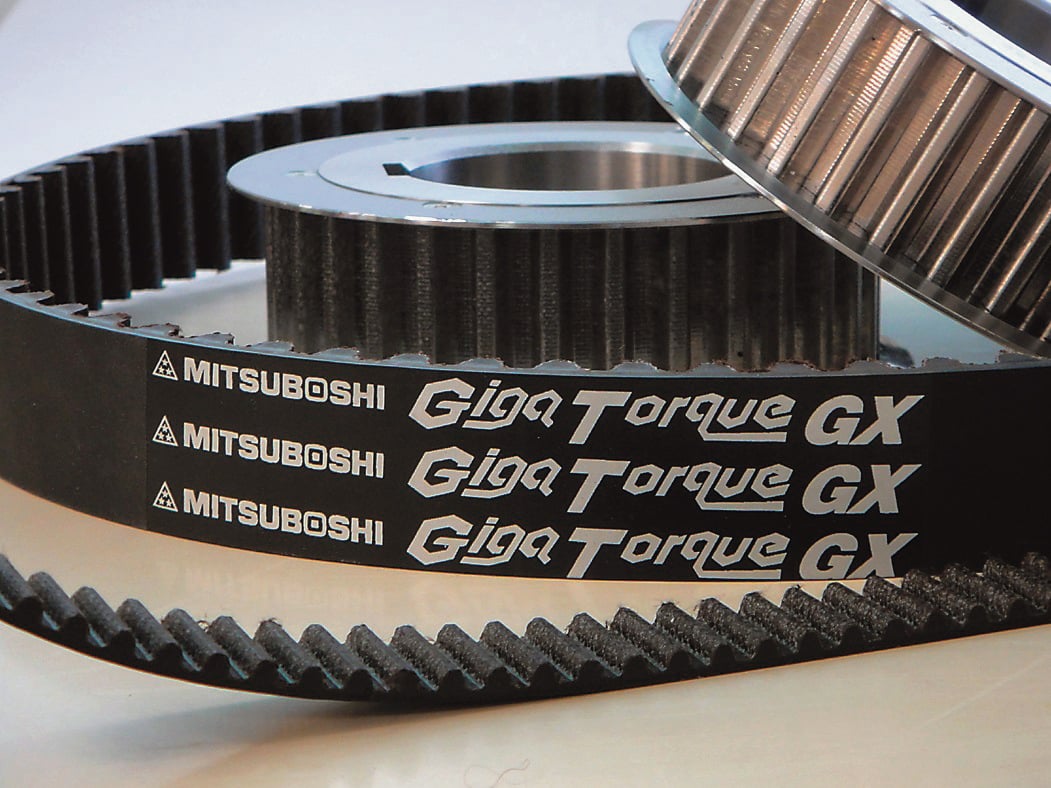
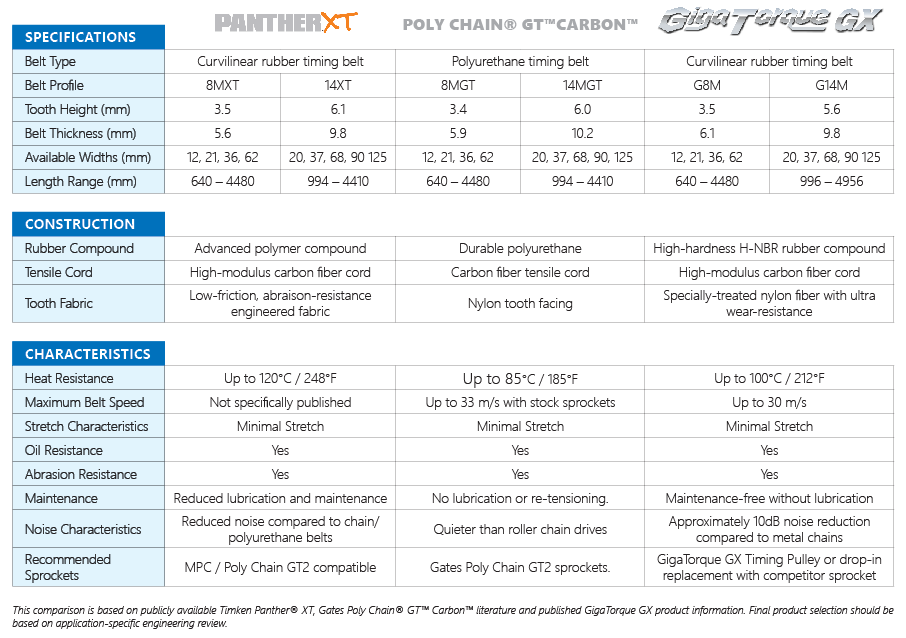
GigaTorque GX combines high modulus carbon fiber tensile cords, a high hardness HNBR rubber compound, and specially treated tooth fabric. Its construction is designed to provide high torque transmission, minimal stretch, low noise, durability, and reliable operation in demanding industrial applications.
GigaTorque GX is available in 8 mm and 14 mm pitches with a broad selection of widths and lengths. It is engineered for high-torque applications commonly served by Gates Poly Chain® GT™ Carbon™ and Timken Panther® XT belt systems, helping simplify the initial evaluation process. Each drive should still be reviewed for sprocket compatibility, power rating, speed, tension, and operating conditions before belt selection.
Make the Replacement About the Drive, Not Just the Belt
A reliable high-torque timing belt replacement begins with more than a part number.
The condition of the existing belt, sprocket geometry, operating load, application environment, belt construction, installation tension, and available technical support should all be considered before making a change.
Taking the time to review the complete drive can help improve reliability, reduce unnecessary maintenance, and prevent avoidable downtime.
Explore the High Torque Timing Belt Replacement Guide for additional guidance on performance, compatibility, technical support, and long term supply considerations.
Explore the guide:
https://www.mblusa.com/high-torque_timing_belt_replacement_guide
Gates Poly Chain® GT™ Carbon™ and Timken Panther® XT are trademarks of their respective owners. References are for product identification and comparison purposes only. No endorsement is implied. Application review is required before belt selection or installation.
How do you choose a high torque timing belt replacement?
Choose a high torque timing belt replacement by confirming the pitch, width, length, tooth profile, sprocket compatibility, power requirements, speed, installation tension, and operating environment. Do not select a replacement based only on the dimensions or part number printed on the existing belt.
Are timing belts with the same pitch interchangeable?
No. Belts with the same nominal pitch are not automatically interchangeable. Tooth geometry, belt thickness, construction, power ratings, and sprocket requirements may differ. Confirm the exact belt and sprocket profile before installing a replacement.
What causes premature timing belt failure?
Common causes include sprocket misalignment, incorrect installation tension, overload, shock loading, worn sprockets, insufficient tooth engagement, contamination, and operating conditions outside the belt’s capabilities. The wear pattern on the removed belt can help identify the likely cause.
Should sprockets be replaced when installing a new timing belt?
Sprockets do not always need to be replaced, but they should always be inspected. Replace sprockets with excessive tooth wear, damaged flanges, worn outside diameters, or incompatible tooth profiles. Alignment should also be corrected before the new belt is installed.
Can the same installation tension be used for a replacement belt?
Not necessarily. Recommended installation tension and measurement methods can vary according to belt construction, width, and product line. Use the technical data provided for the replacement belt rather than automatically applying the previous belt’s tension value.
Can GigaTorque GX be evaluated as an alternative to Poly Chain® GT™ Carbon™ or Panther® XT?
Yes. GigaTorque GX can be evaluated for many high torque applications commonly served by Gates Poly Chain® GT™ Carbon™ and Timken Panther® XT. Each application should be reviewed for belt size, sprocket compatibility, power rating, speed, tension, and operating environment before selection.
What information is needed for a timing belt application review?
An application review should include the current belt size, sprocket tooth counts, driver and driven speeds, center distance, motor power, operating hours, starts and stops, shock loads, ambient temperature, contaminants, and any history of belt or sprocket failure.